
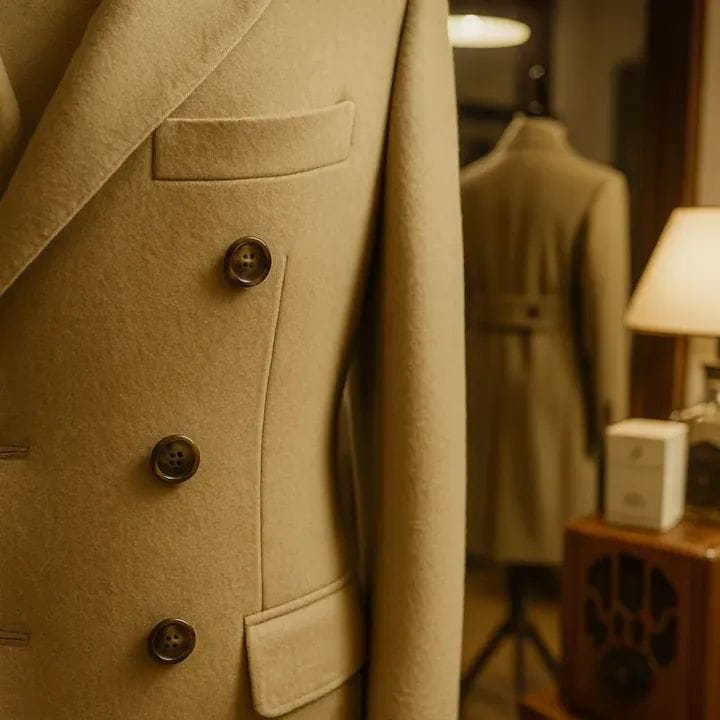
Italian Masters · Sartorial culture
Francesco CarusoThe art of dressing a person
Thirty-five years of tailoring, from the Neapolitan tradition to his atelier in Treviso.
Before there is a jacket, there is a person.
A shoulder that sits slightly differently. A way of standing. The movement of an arm. The life the clothes will have to follow.
For Francesco Caruso, tailoring begins there — not at the cloth, and not at the mirror. It begins in observation: proportion, character, and what a garment will need to do quietly for someone over years, not for a single photograph.
Francesco is a tailor and the founder of Sartoria Caruso in Treviso. He is originally from Naples. Across thirty-five years in the trade, his formation has remained tied to the Neapolitan sartorial tradition, including a training path at the Kiton school — a disciplined apprenticeship in cut, balance and the patience the old workshops demanded.
In Treviso he continues an artisan practice of unique, made-to-measure, hand-built garments in the spirit of the historic botteghe: one person, one jacket, one sequence of decisions that cannot be repeated exactly for anyone else.
This portrait sits within OHH! ITALY’s wider reading of Italy — alongside private journeys, concierge planning, and the slower knowledge we gather before we design an itinerary.
A conversation with Francesco Caruso
Answers translated from Francesco Caruso’s original Italian replies.
Francesco, when you first look at a person, what do you notice before you even think about the suit?
I observe how they carry themselves, their features; I listen to the tone of their voice, I look at their posture and I watch their gestures. Before the suit, I try to know the person.
You say a suit should dress a person, not simply cover them. What does that really mean to you?
A suit that dresses a person is, in fact, the true meaning of made-to-measure. Anything can cover the body — but knowing how to dress it is something else. To dress means to respect the body, to accompany it and to bring out its best.
You were born professionally into the Neapolitan tailoring tradition. What did Naples leave you that you still find in the way you work today?
Professionally, I could say: everything.
The Neapolitan tailoring tradition is a philosophy. It is true that every tailor has their own hand, their own line and their own creative expression — but it is technique that, in some way, unites all the great master tailors.
What do you remember of your training at the Kiton school? Is there something you learned then that you still apply today?
I remember a great deal, but above all I remember a great deal of generosity. I was probably fortunate, because in that setting everyone cared for me. It is something I still carry with me.
There are things that remain unchanged — for reasons of technique and of craft with the hand. Many others, with time and experience, are refined and improved.
After thirty-five years of tailoring, how much still depends on measurement, and how much on the tailor’s eye?
Measurements are the foundation. You are taught how to take them, and with experience you learn to take them better and better. The eye, instead, is something innate. Not every tailor has the same eye; they may be stronger in certain stages of the work. But to bring everything together — technique, handwork and eye — belongs to few.
When you look at a person’s body, what are those small things a tailor sees that the rest of us normally miss?
The posture of the neck, the arms, the shoulders, the pelvis and the position of the legs. To an untrained eye these details may seem insignificant, but for a tailor they can completely change the way a suit must be cut and built.
How much can the way a man dresses tell us about his character? And how far must the tailor adapt to the client’s personality?
The clothes, as they say, usually make the man.
When the measurements are taken and the suit is cut exactly to those proportions, it is no longer the tailor who must adapt to the person: it is the suit that finally finds its other half.
Is there a moment in the making of a suit when you know: “now this suit truly belongs to this person”?
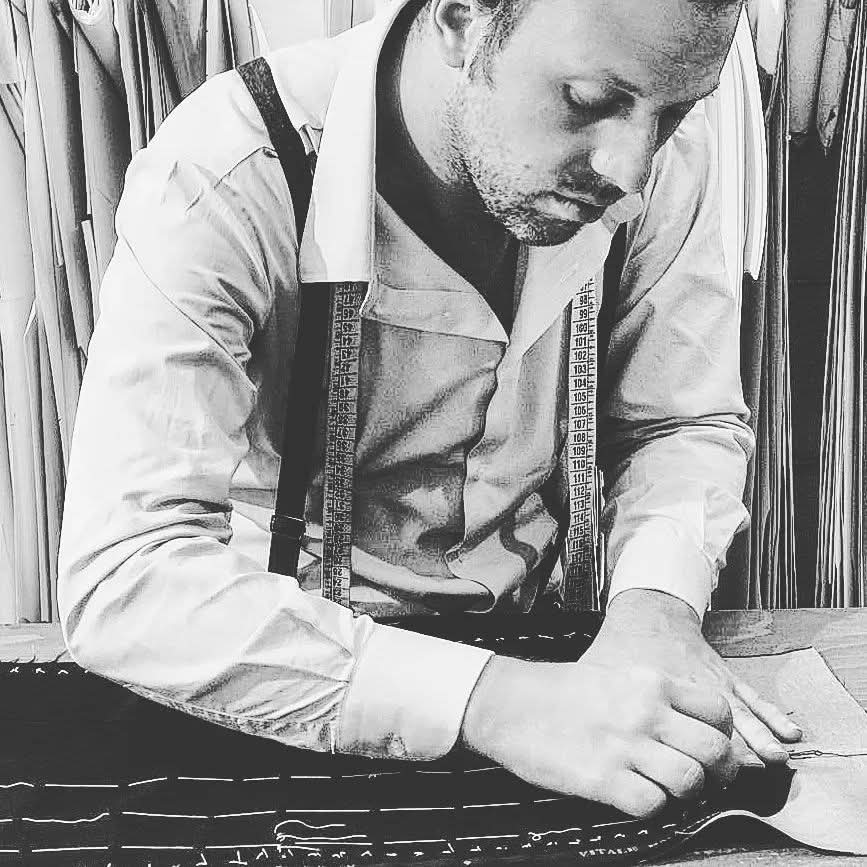
Already when I draw the jacket directly onto the cloth, I begin to see the client. In that moment I already start to see the suit on him.
By the second fitting, let’s say, the garment has already reached about ninety percent of what it will be.
In a world where almost everything can be produced quickly and industrially, what value remains in making something entirely by hand and to measure?
It depends on how much value you give to something you know was born exclusively for you.
Or you can choose a product that was simply waiting to be bought — to become one more number in your wardrobe.
What has been lost from the old Italian tailoring workshops — and what, in your view, should never be lost?
In the true workshops, let’s say, nothing has ever been lost, and nothing ever will be. The problem is that, as in any artistic field — and by now in so many working worlds — everything has become more futile: it seems the only thing that matters is making money and doing business.
But the true craft — the one made of knowledge, sacrifice and passion — should never be sacrificed.
If you had to let someone experience tailoring who had never known it — not simply show them how a suit is made — what would you want them to understand or feel?
I would want them to understand that tailoring is not simply the way a suit comes into being. It is the way a relationship is born between the garment and the person who will wear it.
If for one day we took your craft out of the atelier — into a villa, a historic palazzo, a chalet in the Dolomites — what kind of experience would you want to create for a few people seated around you?
I would certainly show the first part of the work, because that is also the most interesting from a technical point of view: the drawing of the jacket and the cutting.
That is where the cloth truly begins to transform — and where, from a simple piece of fabric, the suit I have imagined begins to take shape.
What is the first thing your hands know how to do that would be hard to explain in words?
Handwork is something I have carried with me since I was a child. The hardest thing to explain is probably the sensation I feel between my fingers when I sew a garment by hand.
There are things the hands learn that words cannot tell.
Have you ever understood something about a person’s character simply by taking their measurements?
More than understand — I would say sense. “Sense” is probably the right word.
For you, does the perfect suit exist — or only the right suit for that person?
No suit, even when made for the same client, will ever be identical to another. They may resemble each other, but every garment will have something different.
So — to say the perfect suit exists: no. But that a tailor can make it almost perfect for that person: yes.
What is an almost invisible detail of a suit that, for you, says a great deal about the quality of whoever made it?
The cut, first of all — and certain details executed strictly by hand. It is precisely these particulars, often almost invisible, that tell the quality of a tailor’s work.
If a young person walked into your workshop today and said “I want to become a tailor,” what is the first thing you would teach them?
I would teach them the herringbone stitches, executed strictly by hand, on the jacket’s lapels and collar.
I would give them needle, thread and thimble.
And without the thimble, I could tell them immediately to change profession.
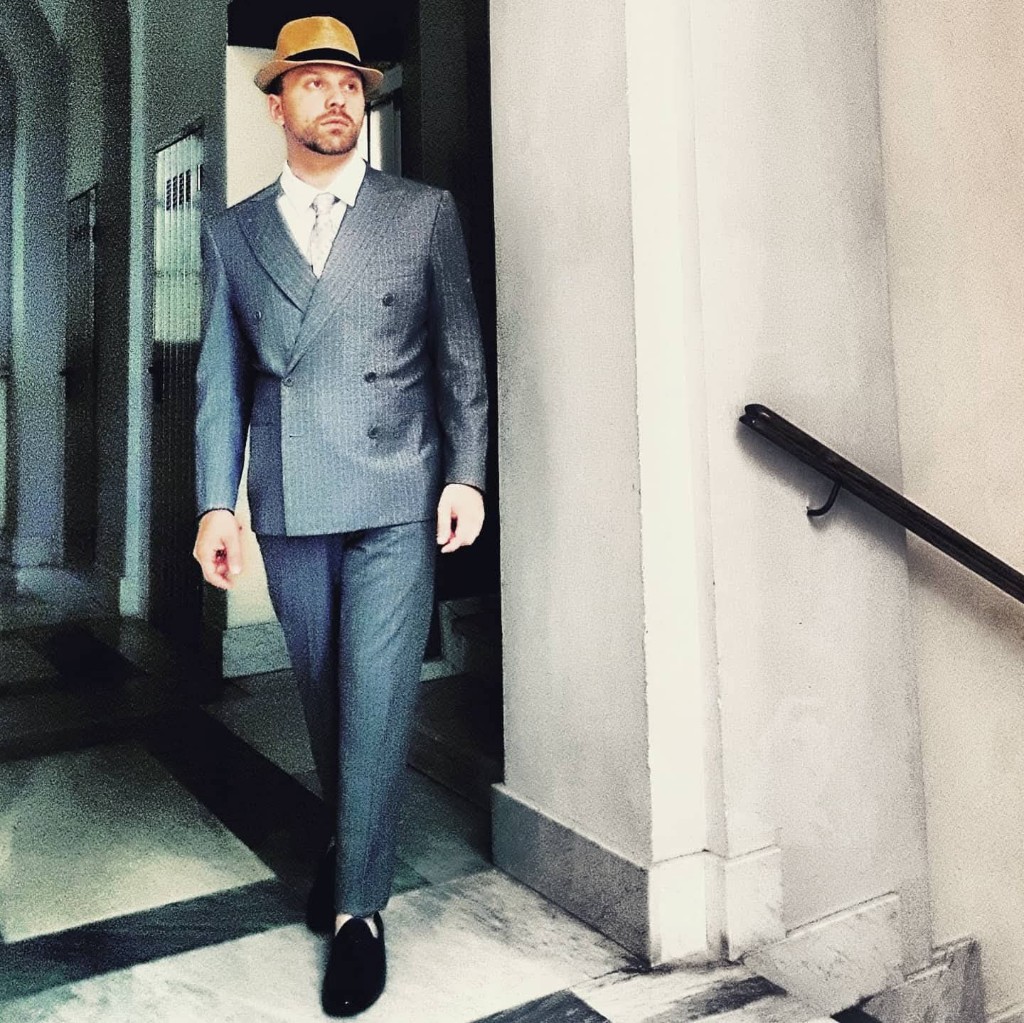
At the end of the process there is no announcement — only cloth that finally agrees with the person inside it. The photograph is not the goal; the years ahead of wearing are.
Particular attention, in Francesco’s practice, is given to construction and to details that remain invisible once the jacket is finished — the architecture that lets a garment keep its shape while moving with the body.
From the atelier to a private setting
When the workshop travels
For OHH! ITALY, meeting an Italian craftsman should not necessarily mean visiting a shop on a fixed itinerary. In selected circumstances, the conversation can come to you — a private room, a residence, a table already set for the day.
The point is not tourism dressed as culture. It is quiet access: time with someone who has spent thirty-five years learning how to see a person before cutting cloth.
A private tailoring masterclass with Francesco Caruso
OHH! ITALY can design, on request and subject to the artisan’s availability, a private encounter centred on Italian sartorial culture — not a group tour, not a factory visit, not a promotional appointment for a brand.
The settings below are examples of environments OHH! ITALY may source and coordinate. They do not imply that Francesco has previously held masterclasses in these places.
A private villa on Lake Como · a historic palazzo in Venice · a private residence in the Dolomites · an Italian castle or country estate · a private salon within a selected luxury hotel · aboard a yacht along the Italian coast · within a private corporate retreat or family gathering.
Understanding proportion
Francesco may explain how a tailor observes the body before measurements are taken — posture, balance, the relationship between shoulder, chest and the way someone moves.
The architecture of a jacket
An introduction to balance, shoulder line, lapel, internal construction and the dialogue between fabric and form — at the level of culture and observation, not a trade-school syllabus.
Cloth
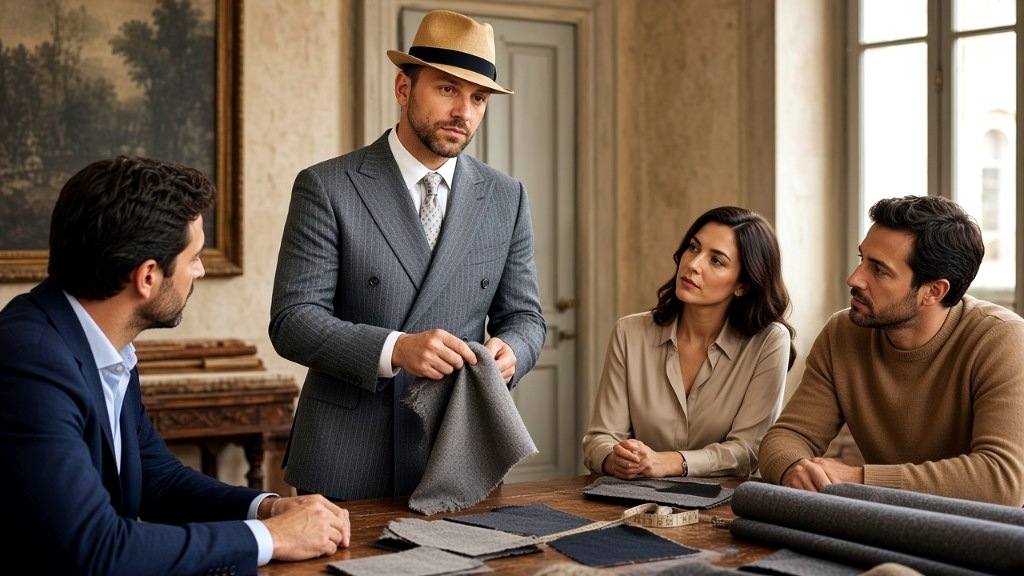
A tactile exploration of weights, textures and how different materials behave — why cloth choice is part of proportion, not decoration.
The hand of the tailor
A closer look at handwork and at details that normally disappear once a garment is finished — the invisible labour bespoke preserves.
Personal style
A conversation about clothing that reflects character without becoming costume — alignment rather than performance.
The fitting
For selected private commissions, the encounter may evolve into the beginning of a bespoke garment — always subject to timing, scope and mutual agreement.
Not a class.
An encounter.
The purpose is not to learn how to make a suit in an afternoon. It is to spend time with someone who has spent thirty-five years learning how to see one.
OHH! ITALY editorial copy — not attributed to Francesco Caruso.
The experience can be shaped for private travellers, small groups, families, collectors, executive retreats, private celebrations, or discreet corporate gatherings — always with contained numbers and a private setting.
The house around the encounter
What OHH! ITALY curates
The atelier arrives. The room, the pacing and the silence around it are designed with the same care as the cloth on the table.
- Setting
A private venue chosen for the conversation — villa, palazzo, residence or salon.
- Journey
Transfers and logistics woven into a wider Italian itinerary, never as an isolated appointment.
- Hospitality
Food and wine around the day, paced as you would want it.
- Language
Interpreting when the conversation needs it.
- Memory
Photography or film on request, with discretion.
The masterclass can sit inside a longer private journey devoted to Italian craftsmanship, design, fashion, architecture, food, wine, collecting or cultural heritage — with the same editorial restraint as the rest of your time in Italy.
Related · Private journeys · Private concierge · Corporate & private retreats
Private encounter
Bring the atelier to you
OHH! ITALY can design a private encounter with Francesco Caruso around your journey, residence or gathering in Italy, subject to availability and the nature of the request.