
Treviso · Italian gastronomy · World championship
Tiramisù World Cup — A Sweet Tradition Goes Global
Celebrating ten editions of the world’s most beloved Italian dessert in Treviso.
01
Treviso, the city of tiramisù
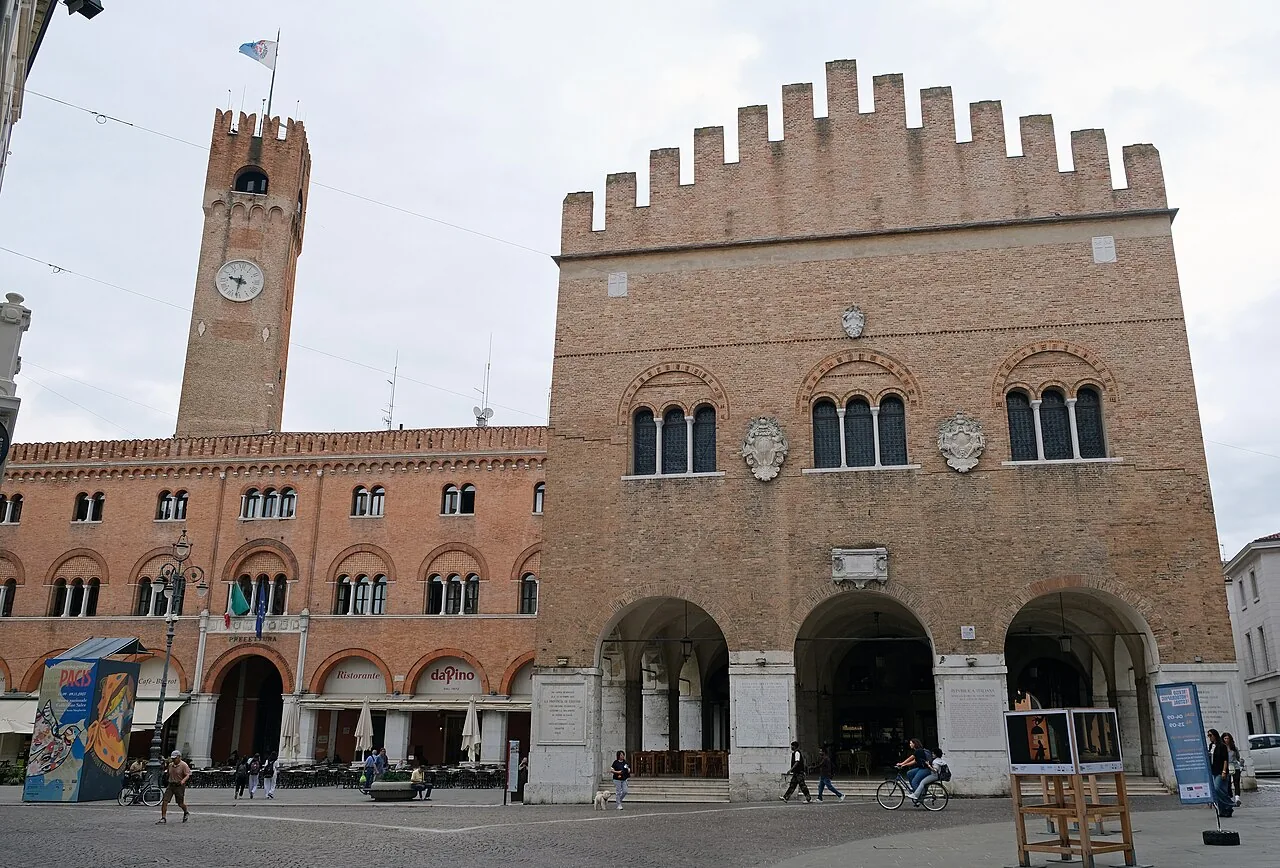
Treviso’s claim is attached to a restaurant, not to a legend that can be dated cleanly. At Le Beccherie, in Piazza Ancillotto, the house account names Alba Campeol and the pastry cook Roberto “Loly” Linguanotto. They place the experiments between 1971 and 1972, and the first menu line — tiramesù, in the dialect of the city — in 1972. The restaurant later filed that recipe with the Accademia Italiana della Cucina. Pick me up: that is the plain sense of the name.
It is not the only account, and this page does not treat it as one. In Tolmezzo, in Friuli, a recipe associated with Norma Pielli at the Albergo Roma is dated to 1959 and was first known as a mascarpone slice. In 2017 the ministry listed tiramisù among the traditional agri-food products of Friuli–Venezia Giulia. The organiser of the World Cup sets the two plates side by side — Le Beccherie and the Albergo Roma — as the pair that suggested what a “traditional” tiramisù might mean in a contest. Treviso has argued for the dessert in public for longer than the cup has existed. The argument is still open.
02
The birth of a world championship
The Tiramisù World Cup began in Treviso in 2017. The first edition was held on 4 and 5 November. Francesco Redi conceived it. Twissen, the travel company he works through, organises it. The idea on the project page is domestic rather than professional: people already say that only someone’s mother has the real recipe, so let them compete.
The rule still follows that idea. A competitor must be eighteen or older, and must not be a food-service professional in the sense the regulation defines — recent work in a restaurant kitchen or a pastry laboratory, or a home food business. Waiters are not counted as professionals. A hotel-school diploma, by itself, is not either.
The organiser’s history of that first weekend records selections along the Sile, including at Villa Emo, and a final at the Chamber of Commerce. It also records 720 competitors, and Andrea Ciccolella as champion of the original recipe. Those figures are the organiser’s. What has stayed constant is the return: rounds may happen elsewhere, and the grand final is kept in Treviso.
03
Ten years of Tiramisù World Cup
- Edition Tenth
- Dates 9–11 October 2026
- City Treviso
- Competitions Piazza Borsa
- Field 320, as announced and as later reported
The tenth edition occupied three days in the centre. The organiser’s programme put the competitions in Piazza Borsa. On Friday 9 and Saturday 10 the selections alternated original and creative, from midday through the evening. On Sunday 11 the semi-finals ran in the morning and the final from three o’clock. Public admission was published as free until the square was full. There was no single ticket that guaranteed a place at the rail.
Before the weekend, the organiser’s release said 320 competitors were ready to compete in Treviso, eighty more than recent editions. After the final, the Treviso and national press reported that same number as the field that took part, from 33 countries, in front of 130 judges who had passed an online test. Each plate had forty minutes. No official results file is reproduced here. The figure 320 is both the number announced and the number the press reported afterwards.
04
Original recipe
The original category is a closed list. Six ingredients must be used, and nothing else on the plate: ladyfingers, mascarpone, pasteurised egg, coffee, cocoa, white sugar. The yolk is compulsory. The white is optional. The organiser supplies them, once. Coffee arrives already made, cool and bitter, from a moka. The cook chooses the shape and the method. The vessel does not: the plate is the organiser’s, not a glass. Decorations on that plate may use only the same six ingredients.
Creative
Creative recipe
The creative category keeps four ingredients as obligatory: mascarpone, egg, coffee, cocoa. The biscuit may be replaced with another biscuit or a sponge. White sugar may be replaced by another sweetener. Honey is not that substitute. On the organiser’s current rules it counts as one of the ingredients the competitor adds, and those additions stop at three. They are brought by the cook, not handed out in the square.
The distinction is the point of the weekend. One title asks whether a person can hold the traditional balance under a clock and a shared list. The other asks what can be added before the plate stops being tiramisù. The rules page that describes both categories refers to the 2026 Treviso final. Quantities and brand names sit in that regulation. They are not repeated here as a recipe.
05
The 2026 world champions
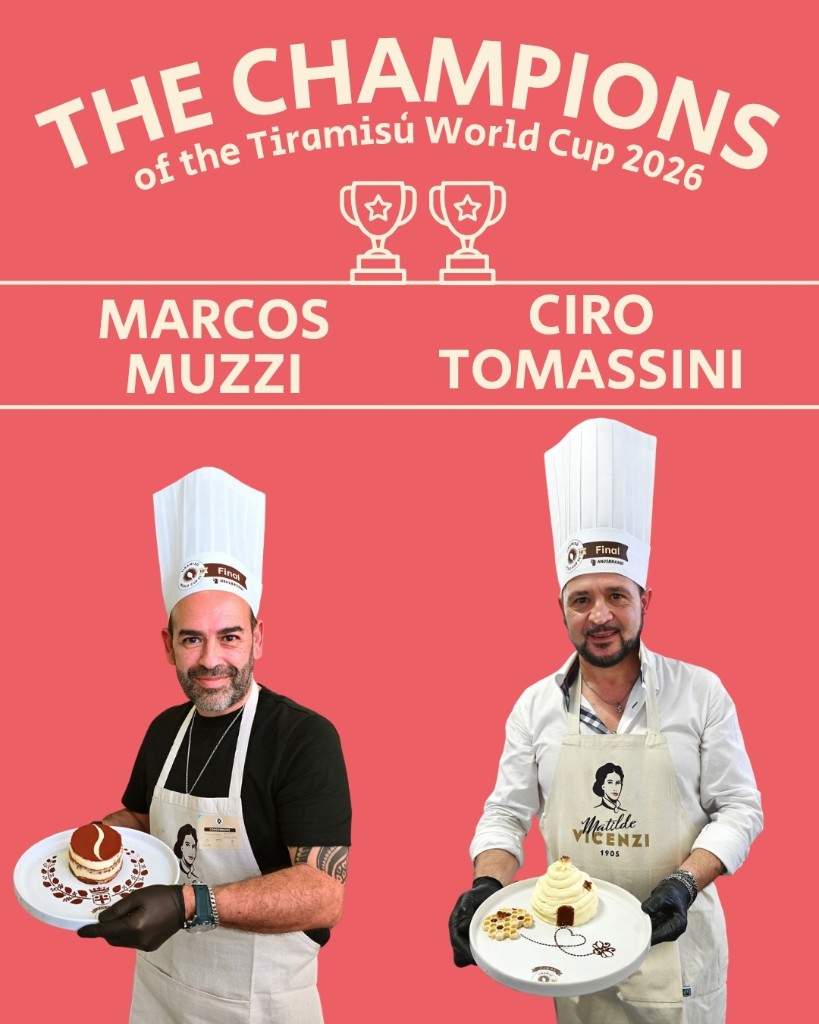
The final on Sunday 11 October named two champions. The portrait is the one issued with the result. Marcos Muzzi holds the cocoa-finished plate. Ciro Tomassini holds the pale dome, with pieces of honeycomb beside it. OHH! ITALY has no interview with either of them.
Original recipe · Brazil
Marcos Muzzi
Marcos Muzzi of São Paulo took the original title. La Repubblica and the Tribuna di Treviso describe him as a 51-year-old beekeeper who stayed with the six ingredients. OHH! ITALY has no interview with him, and invents none.
Creative recipe · Italy
Ciro Tomassini
Ciro Tomassini of Vicenza, 53, took the creative title. Giornale di Vicenza, la Repubblica and the Tribuna agree on the plate: raspberry compote, white chocolate and lemon honey, formed as a honeycomb. Repubblica adds that the shape was offered with endangered species in mind. That is the reported description. It is not a tasting note from this desk.
The same reports place a wider podium behind them. In the original category, Nadia Larbi of Fréjus and Fabiana Borrelli of São Paulo. In the creative category, Juliana Nardelli of Jaraguá do Sul and Giuseppe Salvador of Cordignano, in the province of Treviso. A Brazilian title in the traditional recipe, and a Vicenza title in the variation, is the result the city woke up to. It does not close the argument about where the dessert began.
06
The art of making tiramisù
What the original category protects is a balance. Mascarpone has to remain a cheese, dense enough to carry a layer and not so whipped that it becomes something else. Coffee has to be present and not a puddle in the biscuit. Savoiardi need enough soak to yield and enough structure to hold. Egg and sugar are the body of the cream. Cocoa is the last surface: a bitterness on top of the coffee, not a flavour that replaces it.
Forty minutes and a single supply of ingredients turn that balance into a comparison. Waste is marked down. A second helping of coffee or egg can be asked for if the first was short; the rest cannot. A tiramisù at home has none of those constraints, and no jury. The winning plate is evidence of a rule. It is not a formula published so that it can be copied.
07
A celebration across Treviso
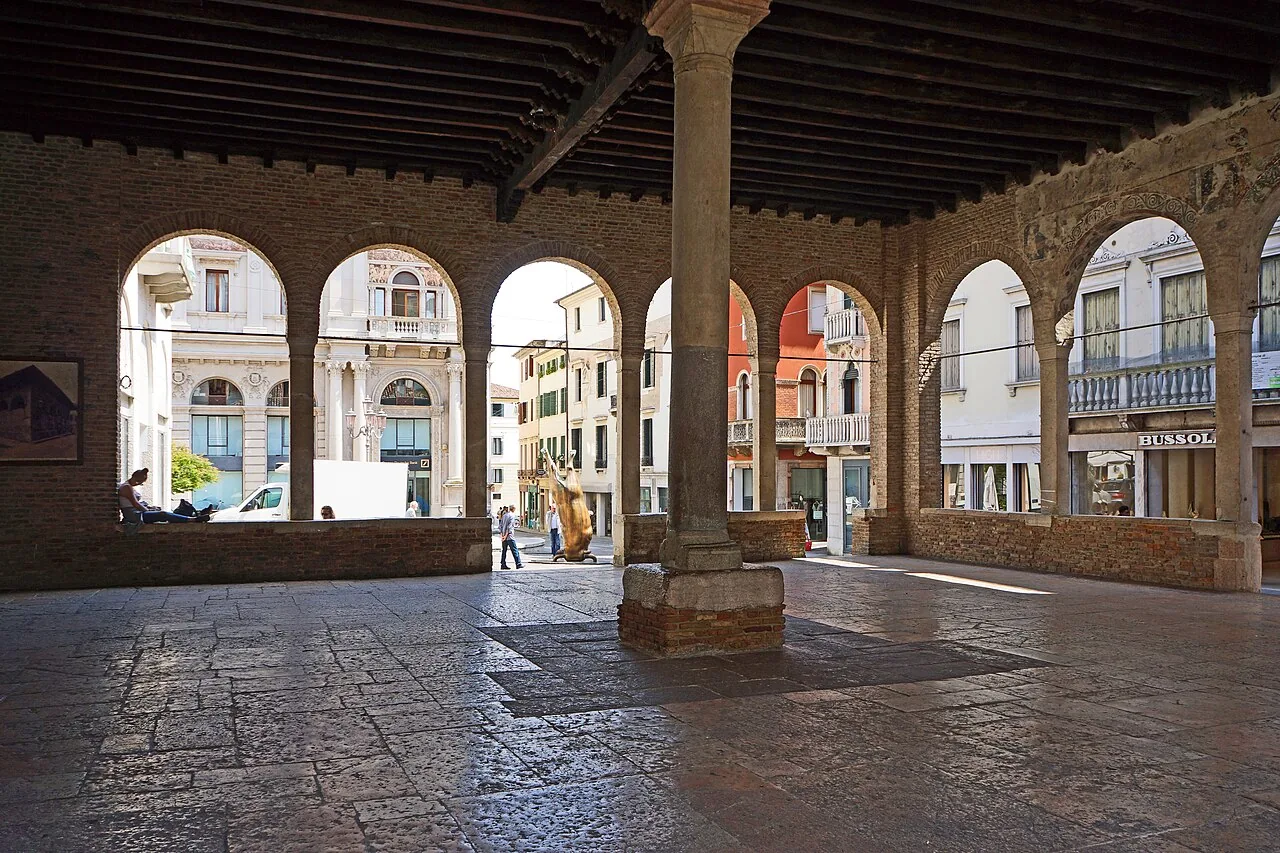
The published programme gave the city two different jobs and kept them apart. Piazza Borsa was the competition. The Loggia dei Cavalieri, at Via Martiri della Libertà 48, was where tiramisù by previous champions was sold: on Friday 9 from two until six, and on Saturday and Sunday from ten until six. The photograph above is of the loggia in 2018. It is not a picture of the 2026 counter.
Around those two places the organiser listed a training room at Tana Libera Tutti, on Viale Burchiellati, with practice stations and classes by earlier champions; a Prosecco tasting of three Venetian denominations; a spritz class; and, beside the square, a gelato stand from Friday to Sunday afternoon. Nordest24 noted that the Sunday morning also belonged to the Mezza di Treviso, so the semi-finals shared the centre with a race. These are lines from the programme and from a local guide to the final. They are not a count of who came, and they are not an offer of places.
08
From Treviso to the world
A championship that refuses professionals and still draws people from thirty-three countries is a precise picture of how this dessert moved. It left a menu in Treviso and a disputed recipe in Friuli, and became something made in São Paulo and Fréjus without asking the city for permission. For three days some of those cooks come back and stand in a square with the same mascarpone and the same clock.
The cup does not award the origin. It shows the reach, and it does so in the city that has the strongest public stake in the story. That is enough work for a weekend. The rest of the year, tiramisù does not need a podium to be Treviso’s best-known export.
09
Discovering the flavours of Veneto
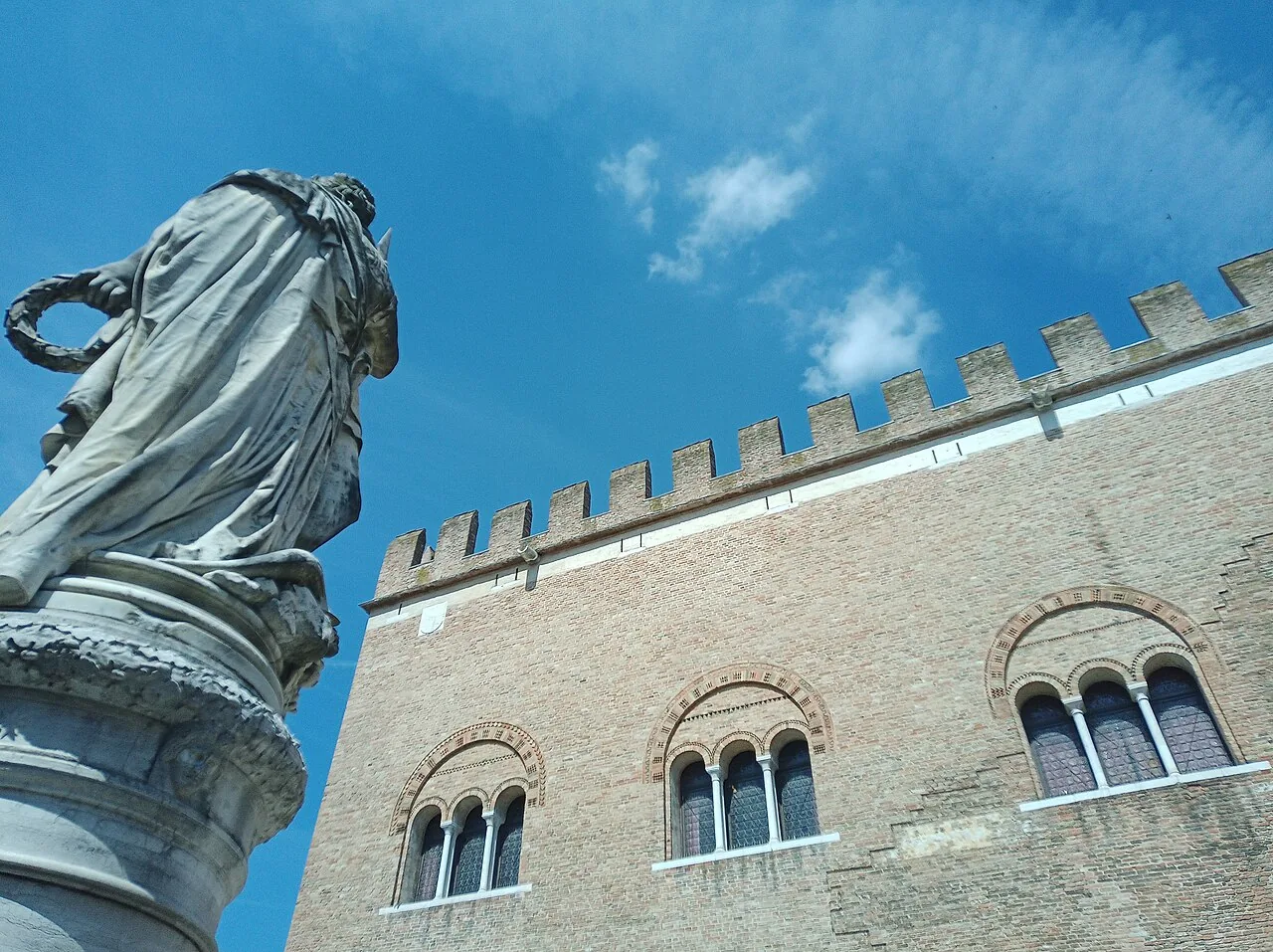
Treviso can be read without the cup. The historic centre, the Sile, radicchio, the road out toward the Prosecco hills of Conegliano and Valdobbiadene. Venetian pastry is a longer shelf than one dessert. None of this is a pass into Piazza Borsa, and none of it is promised as a private table that has already been held.
OHH! ITALY already writes tiramisù as a way of staying in the city, and the Greenway as a way of arriving from Venice. Further into the region, Follina belongs to the hills rather than to the square. The wider field of private journeys can hold a table, a hill and a day in Treviso. OHH! ITALY does not organise the Tiramisù World Cup, and does not claim a door into it.
OHH! ITALY
Experience the flavours of Treviso with OHH! ITALY
Beyond its celebrated tiramisù, Treviso reveals a world of culinary traditions, historic streets and distinctive Venetian hospitality. OHH! ITALY creates tailor-made journeys through the Veneto, connecting remarkable places with authentic local experiences and carefully considered private travel arrangements.
The mark above belongs to the Tiramisù World Cup. It is shown here as information about the tenth edition. It is not a mark of OHH! ITALY, and it does not imply a partnership.
City photographs: Wikimedia Commons, reduced for the web, Astro filter applied. Piazza dei Signori, 22 September 2025 — kallerna, CC BY-SA 4.0. Loggia dei Cavalieri, 7 May 2018 — Roberto Ribotta, CC BY-SA 4.0. Piazza dei Signori, 7 June 2026 — Aktron, CC BY-SA 4.0. Those three plates were not made during the competitions. The tenth-anniversary mark and the champions portrait were supplied for this article and belong to the Tiramisù World Cup. They are shown as information about the 2026 result. OHH! ITALY is not the organiser.